Flying internationally for the first time is equal parts exciting and overwhelming. Between unfamiliar terminals, biometric checkpoints, and rules that vary by country, even well-prepared travelers can get tripped up by things nobody warned them about. This airport guide for first-time international flyers walks you through every stage of the journey from check-in to the departure gate so you arrive informed, not anxious.
Modern airports have changed significantly. Many major hubs now rely on digital systems over human announcements, which means the old habit of “listening for your name” simply doesn’t work anymore. Knowing what’s shifted and what hasn’t makes the difference between a smooth departure and a missed flight.
What Should a First-Time International Flyer Know Before Going to the Airport?
A first-time international flyer should confirm passport validity (at least six months beyond travel dates), complete online check-in within 24 hours of departure, understand baggage allowances, carry physical and digital copies of all travel documents, and arrive at the airport at least three hours before an international flight to allow time for check-in, security, and immigration.
Airport Guide: Pre-Departure Digital and Physical Prep
The Digital ID Era
Most countries now issue e-visas rather than stamped paper documents. Before you travel, confirm whether your destination requires a visa and, if so, apply through the official government portal not third-party sites that charge unnecessary fees.
Store all documents in one place. A travel wallet app (or even a dedicated folder in your cloud storage) should contain:
- Passport photo page (scanned copy)
- E-visa or visa approval letter
- Digital boarding pass
- Hotel confirmation or onward travel proof
- Travel insurance certificate
Also download offline maps for your destination. Airport Wi-Fi is unreliable in many parts of the world, and data roaming charges can be steep.
The 24-Hour Check-In Rule
Online check-in typically opens 24 to 48 hours before departure. Completing it early secures your seat, lets you choose preferences, and means you only need to drop a bag not queue at the full check-in desk. Understanding why flight prices change every day can also help you time your booking and check-in decisions more effectively.
Save your boarding pass to your phone’s wallet or screenshot it in case you lose signal inside the terminal.
Baggage Strategy
Checked baggage fees vary enormously by airline and fare class. Before you pack, check your specific ticket’s allowance not the airline’s general page, which may not reflect budget fare restrictions.
Key rules to know:
- Liquids in carry-on bags must stay under 100ml per item and fit in a single clear 1-litre bag (this applies in the US, UK, EU, Canada, and Australia though enforcement varies)
- Power banks must travel in carry-on luggage only they cannot go in checked bags
- Sharp objects, aerosols above 100ml, and certain foods are restricted or prohibited
Navigating the Airport: What First-Time International Flyers Must Know
Finding the Right Terminal
Large international airports Heathrow, JFK, Dubai, Sydney have multiple terminals, and airlines do not all operate from the same one. Check your terminal number on your boarding pass before you arrive. Taking the wrong terminal shuttle can cost 30 to 45 minutes.
Security Checkpoints
2026 Tech Update: If your airport uses new CT (Computed Tomography) Scanners, you no longer need to remove liquids or laptops from your bag. However, check the signs! If the airport is still using older X-ray machines, the 100ml rule and ‘laptops out’ policy still apply strictly. When in doubt, follow the person in front of you or ask a security officer: ‘Is this a 3D scanner lane?’
Many airports have upgraded to CT (computed tomography) scanners, which allow laptops and liquids to remain inside bags in some lanes. However, not all airports have rolled these out uniformly. Until you see a sign confirming otherwise, remove:
- Laptops and tablets from your bag
- Your clear liquids bag
- Jackets, belts, and shoes (if asked)
- Metal items from your pockets
TSA PreCheck (US), UK-registered trusted traveler schemes, and similar programs in Australia and Canada allow faster lanes worth looking into for frequent future travel.
Passport Control and Immigration
After security, international departures go through an immigration or passport control check. Have your passport open to the photo page. Some airports use biometric e-gates; others require a staffed counter.
Do not use your phone at the immigration counter. Many countries consider it disrespectful and officers may pull you aside for additional questioning. Put it away before you step up.
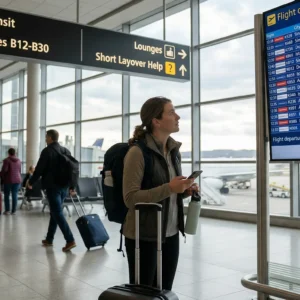
The Silent Terminal Trap: Why Nobody Calls Your Name Anymore
Why 2026 is the year of ‘Quiet Airports’:
Major hubs like Dubai (DXB), Singapore Changi, and London Heathrow have officially moved to a ‘Silent Terminal’ policy. This means if you sit in a coffee shop waiting for an announcement to board, you will likely miss your flight.
The Solution:
Download the airport’s official app or use a flight tracking app like FlightRadar24 to get real-time gate change push notifications directly on your phone.
This is one of the most overlooked aspects of modern air travel, and it catches first-time international flyers off guard regularly. Major international airports including those in Dubai, Singapore, Amsterdam, Toronto, and London have significantly reduced or entirely eliminated personal passenger announcements. They do not call late passengers over the PA system. They do not announce gate changes verbally. You must monitor the screens yourself.
How to Read a FIDS (Flight Information Display System)
The large departure boards you see throughout the terminal are called FIDS Flight Information Display Systems. Here is what to look for:
- Gate number: Can change up to 90 minutes before departure always recheck
- Boarding status: Shows “Boarding,” “Gate Closing,” or “Departed”
- Scheduled vs. actual time: Delays update here before any announcement
Set a reminder on your phone to check the FIDS every 20–30 minutes after you clear security. Never assume your gate matches the one printed on your boarding pass.
Transit and Layovers: A Beginner’s Airport Guide
How Connecting Flights Work
If your journey includes a layover, look for “Flight Connections” or “Transfers” signs immediately after landing. Do not follow signs for “Arrivals” or “Exit” those lead out of the airport, and re-entering the secure zone takes significant time.
For short connections, move directly to your next gate. For longer layovers, check whether your airline has a lounge you can access, or ask at the transfer desk about complimentary rest areas. Read our full layover survival guide for proven strategies to make the most of any connection time.
Do You Need a Transit Visa?
This depends on your nationality and the country you transit through. Some countries require a transit visa even if you never leave the airport. Check your layover country’s immigration rules before you fly not after you land.
Layover Survival Tips
- Changi Airport (Singapore), Hamad International (Doha), and Dubai International offer free rest zones and showers for transit passengers
- Confirm whether your airline transfers checked bags automatically or requires you to re-check them
- If your first flight runs late and threatens your connection, notify a crew member before landing
7 Silent Mistakes First-Time International Flyers Make
1. Confusing Gate Closing Time With Departure Time
Gates typically close 15 to 30 minutes before the aircraft departs. If your boarding pass says “Departure: 14:00,” the gate may close at 13:30. Airlines hold no obligation to wait if you arrive at 13:45.
2. Relying on Airport Wi-Fi
Airport Wi-Fi is often slow, requires registration, and drops in busy terminals. Download your boarding pass, offline maps, and any documents you need before you leave home.
3. Packing a Power Bank in Checked Luggage
Lithium battery regulations prohibit power banks in checked bags on most international airlines. Pack them in your carry-on. Batteries above 100Wh (typically above 27,000mAh) require airline approval in advance.
4. Ignoring Terminal Numbers
At airports like Heathrow, JFK, and Dubai, wrong terminal arrivals are common among first-time travelers. Some terminals require bus or rail transfers that take 20 minutes or more. Confirm your terminal the night before.
5. Inconsistent Liquids Rule Interpretation
The 100ml rule applies container-by-container, not in total. A 200ml bottle that sits half empty still fails the check. Each container must hold 100ml or less, and all containers must fit in one clear, resealable 1-litre bag.
6. Using Your Phone at Immigration
Checking your phone, taking photos, or being distracted at the immigration counter raises a security red flag in many countries. In the UAE, UK, and several other jurisdictions, officers may pull you aside for additional questioning. Keep your phone pocketed until you clear the checkpoint.
7. The Passport Validity Trap
Many countries require your passport to stay valid for at least six months beyond your entry date — sometimes longer. Even if your passport has not technically expired, airlines may deny boarding if it falls within six months of expiry. Check each country’s specific requirement before booking.
International Airport Experience: What to Expect at Each Stage
| Stage | What Happens | Time to Allow | Key Tip |
|---|---|---|---|
| Check-In / Bag Drop | Verify identity, receive boarding pass, drop checked luggage | 20–45 min | Complete online check-in beforehand to use the faster bag drop queue |
| Security Screening | X-ray of bags, body scanner, item removal | 15–40 min | Wear slip-on shoes; pack liquids at the top of your bag for easy access |
| Passport / Immigration Control | Document verification, biometric scan or officer check | 10–30 min | Phone away, passport open to photo page, answer questions briefly and honestly |
| Gate Area | Wait for boarding call; monitor FIDS for gate changes | 30–90 min | Recheck FIDS every 30 minutes; do not wander too far from your gate area |
| Boarding | Boarding pass scan, seat assignment, onboard | 20–40 min | Board in your zone; overhead bin space fills fast on full flights |
| Arrival / Customs | Baggage claim, customs declaration, exit | 20–60 min | Complete customs form on the plane if provided; declare items when in doubt |
Frequently Asked Questions
How early should a first-time international flyer arrive at the airport?
First-time international flyers should arrive at least three hours before departure. This allows adequate time for check-in, bag drop, security screening, passport control, and reaching the gate all of which take longer than expected at large hub airports with multiple terminals during peak travel periods.
What documents do I need for my first international flight?
You need a valid passport (with at least six months of validity beyond your travel dates), a visa or e-visa if your destination requires one, and your boarding pass printed or digital. Some countries also ask for proof of onward travel, accommodation details, or travel insurance at the immigration counter.
Can I carry a power bank on an international flight?
Yes, but only in your carry-on luggage never in checked bags. Most airlines permit power banks up to 100Wh (approximately 27,000mAh) without prior approval. Larger capacity banks require advance written permission from the airline. IATA guidelines apply universally, regardless of which country you depart from.
What happens if I miss my connecting flight due to a delay?
If the airline caused the delay and your connection sits on the same booking, the airline must rebook you on the next available flight at no extra charge. Notify cabin crew before landing if your delay runs significant. If your connections sit on separate bookings, you may need to purchase a new ticket independently. Review your passenger rights before you fly so you know exactly where you stand.
What does “gate closing” mean on an airport departure board?
Gate closing means the aircraft door is about to shut and boarding has ended. At this point, even if you stand in the terminal, the airline cannot guarantee boarding. Gate closing typically happens 15 to 30 minutes before the scheduled departure time. Passengers who miss this window usually receive a no-show status.
Your Ready-to-Fly Checklist Before You Leave Home
International travel carries layers of process that domestic flying simply does not. Most problems first-time flyers encounter do not start at the airport they start from preparation gaps in the 24 hours before departure.
Before you leave, confirm the following:
- Passport stays valid for at least six months beyond your return date
- Visa or e-visa is confirmed and saved digitally
- Online check-in is complete and boarding pass is saved offline
- Baggage allowance checked and liquids packed correctly in carry-on
- Power bank sits in carry-on, not checked bag
- Terminal number confirmed and travel time to airport calculated with buffer
- Offline maps and documents downloaded
- Transit visa requirements reviewed if you have a layover
Airports are designed to move large numbers of people efficiently. When you understand the system check-in flows, FIDS screens, immigration protocols, and gate timing the process becomes considerably less stressful. The goal is not to rush through everything; it is to be in the right place at the right time, with the right documents ready.
About Us:
If you found this guide useful, DreyTravel covers the practical side of air travel in depth from understanding why flight prices shift daily to decoding how airlines actually set ticket costs. Whether you are planning your first international trip or trying to make smarter booking decisions, the site breaks down complex travel topics into straightforward, honest information. No sponsored recommendations, no booking pressure just research-backed guidance for travelers who want to fly informed.